


August 18, 2026
Why I Keep Going Back to fintech_devcon
By Aaron Junod, Chief Product Officer
I just got back from fintech_devcon in Denver, and I'm still thinking about it.
That happens every year. Not because of the swag or the keynotes or the hotel coffee. It's the room. If you've never been, here's the shortest way I can describe it: it's a few hundred people who actually build financial services software, in the same place, for a few days, with their guard down. That's rarer than it should be.
A conference that's actually for builders
Most industry events are built for the people who buy things. The agenda is a runway for sponsors, the talks are lightly reheated sales decks, and the real conversations happen in spite of the program, not because of it.
fintech_devcon is the opposite of that. Moov built it as an event by developers, for developers, and they mean it. No sales pitches. The sessions are people getting up and telling you what they actually shipped, what broke, and what they'd do differently. The whole room is builders. You can feel it. You ask someone what they're working on and you get a real answer, usually with a caveat about the part that's held together with duct tape.
That matters more in our industry than in most. Moving money is unforgiving. The edge cases have real consequences, the failure modes are the whole job, and almost none of us can talk about the hard parts in public most of the year. So when you put a few hundred people who've all fought the same battles in one room and tell them "no pitches, just share what you learned," you get something you can't get anywhere else. You get shortcuts. You get "oh, we hit that too, here's what we did." You get a year of trial and error compressed into a hallway conversation.
That's the value. Not the badge, not the venue. The compression of hard-won lessons, handed to you by people who have no reason to spin it.

My proof point
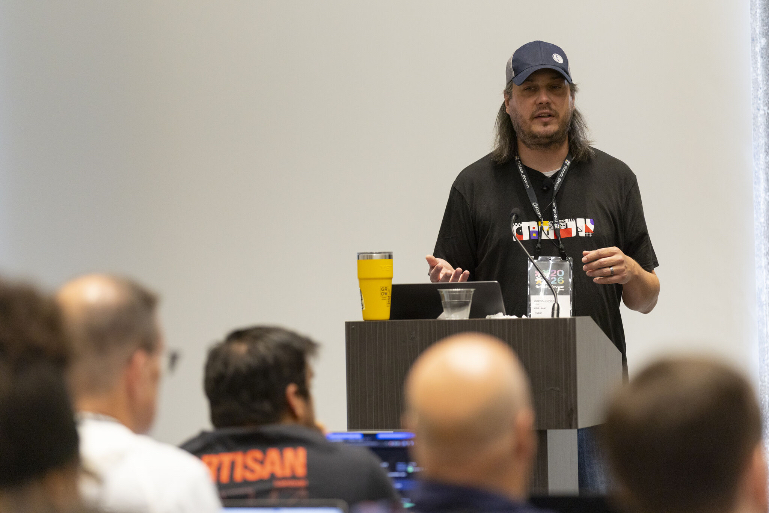
I've had the privilege of speaking at a number of these now, and this year I got to run a hands-on workshop I called Moving Money Without Losing Your Mind.
The premise is simple. Distributed payment systems fail in ugly, specific ways. A worker crashes mid-transfer. A retry double-charges someone. The bank says no halfway through a multi-step flow. An API times out and now you genuinely don't know whether the money moved. So instead of talking about that, we built it. Everyone in the room built a payment orchestrator on Temporal, and then we broke it on purpose. Worker crashes. Double-charges. Compensation when the bank rejects. Holding a big transfer for a human to approve. The mock bank was rigged to fail based on the transaction amount, so the whole room hit the same wall at the same time, which made the "oh, that's what durable execution is for" moment land together.
I leaned on Temporal because it isn't a demo prop for us. It's a primitive in Mesh, our platform, and every application we build at Trabian sits on it. Temporal is how we get the dimensions financial services actually demands, mostly for free: durability so a crash doesn't lose the transaction, idempotency so a retry doesn't move money twice, compensation so a partial failure rolls back cleanly, human-in-the-loop so a person can approve the big ones, and a full history of what happened so you can answer the auditor honestly. Those aren't nice-to-haves in this business. They're the job. Building them by hand, over and over, per app, is how you lose your mind. Making them a primitive is how you don't.
If you want to poke at any of it, both the slides and the full workshop are public:
- Slides: https://github.com/junoddev/temporal-payments-slides
- Workshop: https://github.com/junoddev/temporal-payments-workshop
Clone it, break it, steal from it. That's the whole point.
The part I didn't expect to matter most
Here's the thing that stuck with me, though. It wasn't the talk. It was what happened around it.
I had the first time slot of the conference, so I figured that was that. Say my piece, then blend into the crowd for the rest of the week. That's not what happened. For the next few days, random attendees kept coming up to thank me, in hallways, over coffee, in line for lunch. Some were working through the exact problems we'd just simulated. Some were just glad someone said the quiet parts out loud. It kept going right to the end. At the after party, as I was packing up I ran into two more people who had been at my session, and they were really appreciative of my talk. That one stuck with me. That generosity runs both directions at this event, too. I gave a workshop and I still walked away with a notebook full of things other people taught me.
And so much of it is the people. I got to catch up with old friends I've known for years in this space, and I met a bunch of new ones. Everyone is welcoming in a way that's hard to fake. Nobody's guarding their moat. The person you're comparing notes with at lunch might be at a competitor, and it doesn't matter, because we're all trying to move money without losing our minds, and it's a lot easier to do that together.
Go next year
So this is my pitch, and it's the only one you'll get out of fintech_devcon: if you build in this industry, go. Submit a talk. Sit in the front. Ask the awkward question. Stay for the hallway conversation after.
A big thanks to Moov for building the event our industry actually needed, and to everyone who came to the workshop and made it what it was. See you next year.